Control Panel Cable Routing & Separation
Control panels house all the electrical components that control, monitor, and protect machinery and automated systems. In other words, they’re the brain and nerve center of your operation.
Because this is the center of some of your most critical operations, the decisions about how conductors are routed, separated, and secured directly impact almost every aspect of your business. On top of this huge job, control panels are often subject to some of the most stressful industrial environments, where they might be exposed to vibration, dust, heat, moisture, and electrical noise.
Control panel cable routing is where safety, performance, and maintainability converge. It’s also a place where many control panel setups fall short. Here’s how to make sure you get the routing and separation right for optimal performance.
Key Takeaways
- Cable routing and the separation of high voltage and low voltage wiring are code requirements, not just best practices.
- Noise-sensitive circuits in industrial environments need clear, strategic cable routing strategies.
- The right hardware, from tie mounts to spiral wrap, makes a huge difference in both performance and maintainability.
Why Cable Routing and Separation Matter
The decisions you make about routing and separating conductors and cables have a big impact on your operations. These choices directly determine whether a panel will pass inspection and, moreover, whether a panel is going to perform reliably for years to come.
When cables in a control panel aren’t properly routed, separated, or secured, the panel can become a source of chronic signal problems, heat issues, and troubleshooting nightmares. In industrial environments, it’s particularly important that a panel is easy to maintain and protect from interference, because a misstep can lead to costly downtime.
Safety and Code Compliance.jpg)
Code compliance is always crucial. Your control panels must pass inspections and must be up to code. Failure to do so can cause hassles, be costly, and even lead to legal issues or costly rework. Codes that apply include:
- NEC Article 725: Class 1, 2, 3 separation requirements.
- UL 508A Internal separation expectations.
Proper routing practices are among the most common inspection failure points and one of the most preventable.
Signal Integrity and EMI
Signal integrity is another vital consideration. EMI can disrupt and interfere with analog and communication signals. The interference generally comes from power conductors, but it can be difficult to pinpoint and diagnose after installation. Your best primary defense against EMI is to include separation and barriers within your control panel routing.
Determining Routing and Separation Needs
How do you determine the routing requirements and needed separation? It begins with defining the voltage classes within your setup. Line voltage (120V+) drives loads and also generates a significant amount of noise.
Low-voltage control (24V DC and below) covers logic, signaling, and feedback. These circuits are highly susceptible to noise. For the two categories of voltage classes, you need to have two dedicated routing paths.
The minimum separation guidelines are generally 2” between power and control conductors. When the paths must intersect, they should cross at 90 degrees. For constrained spaces, metal barriers can provide a substitute when space is limited.
Routing Noise-Sensitive Wiring: Analog and Communication Lines
When wiring is noise-sensitive, it requires a higher level of attention to routing as compared to other conductors. Analog signals and industrial communication lines both carry low-level signals that are easily overwhelmed by interference from nearby power conductors.
When interference is a problem, it can be very difficult to diagnose after installation. Often, the panel seems to function correctly. But then a process fault will be traceable back to a corrupted signal or dropped communication.
Dedicated routing strategies aren’t optional. They help you protect the integrity of your system’s data. It’s far better to approach routing proactively than to try to reactively resolve an issue down the road.
Analog Signal Wiring
For analog signal wiring, a dedicated duct, separated from line voltage and digital control, is typically the best direction to go. Shielded cable should be grounded at one end only (avoid ground loops). The shield should typically be grounded at the panel end. Best practice is to always keep the runs short within the panel.
Communication and Data Lines
Modbus, Profibus, and EtherNet/IP should be treated like analog wiring for separation purposes. With these lines, be sure to follow the manufacturer's bend radius and separation specs. As for shielding and grounding, it varies by protocol, so be sure to check the device documentation and follow recommendations.
Airflow Considerations
One of the biggest considerations for routing control panel lines is airflow and temperature. Routing impacts the temperature greatly. An overfilled duct will trap heat and restrict airflow, creating a much higher temperature environment.
Bundled high-current runs also experience cumulative heat, which means you must derate (reduce) the maximum allowable current (ampacity) for each conductor in the bundle. For example, a wire rated to carry 20 amps in an open-air environment may only be able to safely carry 15 amps when it’s bundled with other current-carrying conductors. This is governed by NEC Article 310 ampacity correction factors and is not simply a best practice, but also a code requirement. Heat can raise the overall temperature around each wire and stress the insulation.
Best practice is to route away from heat sources like drives, transformers, and power supplies. By doing this, you’ll increase the long-term reliability and safety of the installation.
Design your routing to promote airflow, with sufficient clearance between duct runs and ventilation paths. Avoid blocking the fan or heat exchanger airflow with wiring. At the end of the day, routing is really a thermal management decision. Planning routing carefully will keep your temperatures down and extend the life of your panel.
Maintenance Access
Another important consideration when routing is accessibility. Can maintenance access and service the components as needed?
Conductors should be traceable from source to termination—without disturbing any adjacent wiring. There should be some amount of slack at the termination points to allow for component removal and replacement. A general guideline is to leave at least 6-8 inches of service loop at termination points to accommodate.
Generally, it’s best practice to group each run by function—power, control, and signal—keeping them separate and distinct. It should be easy for maintenance to understand the run, whether it’s in a month or five years down the road.
To the same end, labels and documentation are critical for successful and safe runs. Label both ends and follow the UL 508A requirement to match wiring diagrams.
Use labeling tools such as wire markers, heat-shrink labels, and ferrules at terminations. These tools help users identify wires at a glance. There are many helpful components designed to help you organize control panels efficiently and clearly.
Most importantly, keep your schematics current and update any changes or modifications. When a panel is modified without updated documents, it becomes a puzzle no one wants to solve and a liability to the entire operation.
Cable Management Hardware
Hardware is a crucial part of cable organization and management. Not only does hardware help ensure the installation is smooth and as planned, but it also helps future maintenance issues get addressed quickly and seamlessly.
Wire Duct
Wire duct is the backbone of organized routing. Slots allow easy access to wires and components. Generally, fill to 50-60% maximum. By allowing and planning in space, you’ll have more room to support airflow and for future additions and updates. Always plan separate runs for power cables vs. control and signal cables.
Tie Mounts and Cable Ties
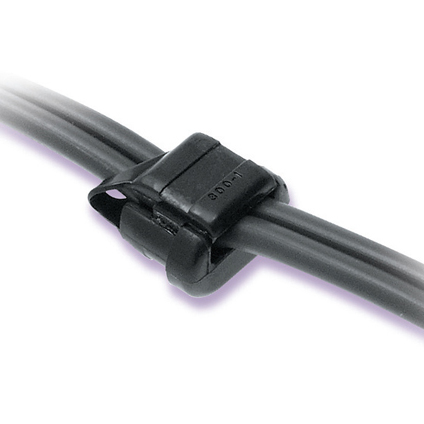
Simple cable ties and tie mounts help you keep routing organized. Secure conductors outside of the duct run to their terminal blocks and other components. Be sure to secure cable ties snuggly, but not too tightly—tight ties can crush conductors and damage insulation. Select ties rated for your panel’s operating temperature. For example, standard nylon ties can become brittle in high-heat conditions and fail.
Spiral Wrap
Spiral wrap is a good solution for moving components as it bundles and protects without sacrificing any flexibility. The wrap is ideal for door-mounted devices and operator interfaces. When using spiral wrap, be sure not to overpack, which can restrict movement and cause chafing. Choose a spiral wrap diameter that can accommodate the bundle and avoid forcing conductors into an undersized wrap, which can impair flexibility.
Strain Relief
Strain relief fittings are required at panel entry points, door hinges, and terminations. These protect cables and prevent mechanical stress from reaching the conductor or connection. Match the fitting to the bundle’s outer diameter, again being sure not to go too loose or too tight, as both can cause problems.
Common Routing Mistakes to Avoid
A few common issues tend to arise with cable routing. Follow best practices, ensuring that you’re always working carefully and up to code. Some common issues to avoid include:
- Putting power and signal cables in the same duct.
- Overfilling wire ducts.
- Not accommodating the minimum bend radius.
- Failure to leave slack at termination points.
- Missing strain relief protection at entries and in moving assemblies.
- Inconsistent, poor, or missing conductor labeling.
- Failing to document the process.
The best guideline is to always leave plenty of space in the duct. Airflow is crucial for control panel operation and will help ensure your panel doesn’t overheat.
Avoid interference by keeping power and signal cables separate. At a minimum, use separation tools if they are housed in close proximity. Also, remain cognizant of flexibility and include strain relief at critical points.
Finally, organizing and labeling will make future maintenance, upkeep, and expansion much easier. Document every change and use cable management best practices to ensure all cables are easy to identify.
When routing is done right, you get better performance, cleaner inspections, and a lower overall lifetime cost. Small hardware decisions can make an outsized impact, especially when done proactively.
Get what you need for control panel routing at IEWC. We’re here to help you with industrial cable and wiring needs, and to help you set up your installation for success.
Related Resources
What is a Cable?
Cable, or cabling, consists of the twisting together of two or more insulated conductors.Learn More
High Voltage Wire & Cable Guide
High-voltage or HV wire and cable are necessary for many industrial applications that rely on dependable high-power transmission. Whether you’re looking for the right HV cable for your application or trying to learn more about how HV wire and cable work, we’ll break it down for you.Learn More
How to Choose the Right Wire or Cable
In selecting a wire or cable for an application, several factors should be considered. Learn More