Control Panel Wiring: Color Codes & Industry Standards
Industrial control panels must meet some strict regulatory as well as safety requirements. That means wiring practices aren’t just a matter of organization. It’s a matter of safety, inspection approval, and long-term reliability.
One important tool for identifying voltage levels, conductor function, grounding, and control circuits is color codes. The standard colors give you a message, and the key is to understand what it’s communicating.
Today, we’ll explore key electrical control panel wiring standards and the widely accepted conductor color conventions used for identification.
Key Takeaways:
- UL 508A governs how industrial control panels are constructed, while the NEC governs how they are installed and protected within a facility.
- Conductor color codes enhance clarity and safety but are largely based on industry convention. Consistency and documentation are essential.
- Proper circuit segregation, labeling, and component selection reduce inspection issues, improve serviceability, and protect long-term operational reliability.
Why Wiring Standards Matter in Industrial Control Panels
Standards such as UL 508A and NEC help establish baseline compliance requirements. Additionally, manufacturers and integrators also apply additional conventions to their wiring. There are several reasons why industrial control panel wiring standards are such a key piece of information.
Safety and Risk Mitigation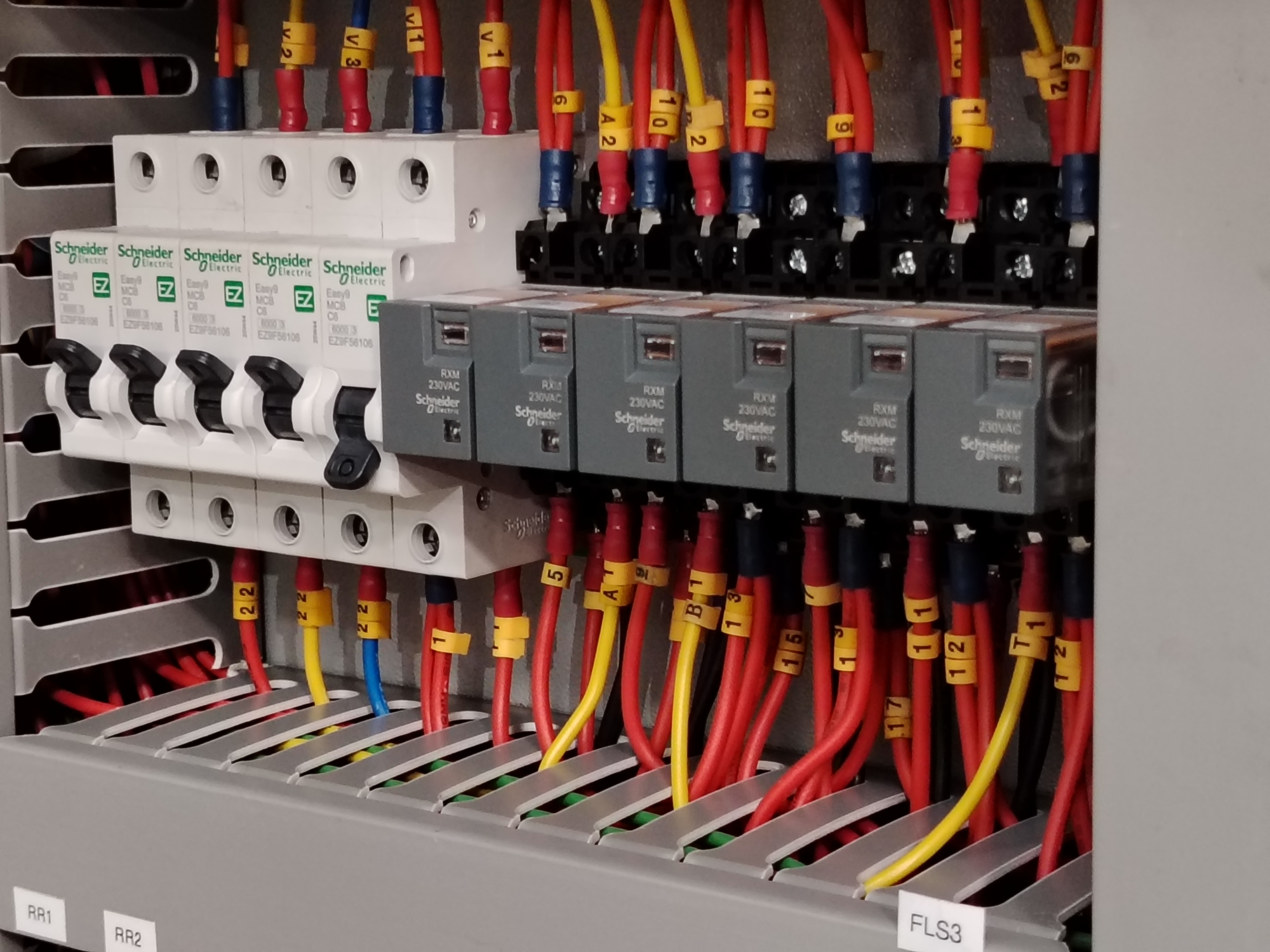
The biggest reason why industrial control panel wiring standards are in place is to protect against safety hazards. Arc flash prevention and shock hazards are risks when working with control panels. Color-coding helps lower the risk of wire misidentification and keeps maintenance crews safe when working with industrial wiring.
Code Compliance and Inspection
Hand-in-hand with safety are the code requirements. UL Listing requirements, NEC Article 409 (Industrial Control Panels, and NFPA 79 (Industrial Machinery) are in place to ensure that installations comply with safety standards. Documentation is your best mitigation should compliance come into question, or should you need to pass inspection.
Long-Term Serviceability
In addition to protecting people, the codes also help protect equipment from damage that can be caused by inconsistencies. For example, troubleshooting the wire speed and having a clear understanding can help you prevent downtime and outages down the road. It also assists with consistency across facilities, so you can be sure that every location under your purview is on the same page.
Key Electrical Control Panel Wiring Standards
What are some of the key electrical control panel wiring standards? There are many standards in place that depend on the component, the size, and the capacity. The majority of control panel wiring falls under the following standards.
UL 508A – The Foundation for Industrial Control Panels
UL 508A is the primary safety standard governing industrial control panels in the United States. It establishes construction requirements for factory-built panels operating at 600 volts or less and is the benchmark for obtaining a UL Listing Mark. The standard applies to both standalone and machine-integrated control panels, but not field-installed wiring. UL 508A guides what happens inside the panel, including component selection, conductor sizing, spacing, short-circuit protection, labeling, and required documentation.
One of the most critical elements of UL 508A compliance is the panel’s Short-Circuit Current Rating (SCCR). The SCCR identifies the maximum fault current the assembly can safely withstand. Control panels require proper calculations, ratings, and marks to ensure they’re suitable for the fault current at the installation site.
The standard also establishes the minimum spacing between live components, the conductor ampacity, and the temperature requirements. The standard outlines identification rules to support inspection, troubleshooting, and long-term safety measures.
National Electrical Code (NEC)
NEC governs electrical installation, not just the panel construction—it applies to the entire building’s electrical system. The NEC is in place to ensure safe installation and protection from overcurrent. UL508A tells how a panel should be built, whereas the NEC tells us how the panel should be installed, supplied, and protected within a facility.
- Article 409 covers industrial control panels and requires that panels be marked with SCCR. It also references the UL 508A compliance, defining installation requirements and ensuring panels are properly supplied and protected.
- Article 310 covers conductors and gives guidance for the ampacity tables and required insulation types. It includes conductor materials, installation conditions, and temperature ratings. It tells you what size wire must be used under specific load and temperature conditions.
- Article 250 covers grounding and bonding—the proper equipment grounding conductors and the guidelines for bonding of enclosures. It covers the fault current path integrity and protects against improper grounding, which can lead to inspection failure and present a shock hazard.
The separation of Class 1 and Class 2 circuits helps prevent the risks that come from mixing high and low voltage wiring. Class 1 circuits have higher voltage and higher power. Class 2 circuits have limited energy and are often found in control or signaling circuits.
The NEC requires physical separation, separate wiring methods, and proper identification. These articles define conductor sizing, grounding requirements, and circuit separation. The goal is to prevent overheating, shock hazards, and any interference that may come between voltage classes. They’re in place to make all wiring safer.
NFPA 79 – Electrical Standard for Industrial Machinery
NFPA 79 covers industrial machinery specifically, with a stress on operational safety. NFPA 79 covers machine control panels, including requirements for emergency stops and safety interlocks. It typically works alongside the NEC and provides additional safety requirements for control panels.
This standard also offers recommendations for conductor color indication to differentiate components used in industrial equipment.
NFPA 79 recommends:
- Green/Yellow: Equipment grounding
- Red: AC control circuits
- Blue: DC control circuits
- Orange: Externally powered circuits that remain energized when power is off
- Yellow: Interlock wiring
Keep in mind, these are recommendations, not hard mandates, in most cases, but the color coding is widely followed.
CSA / International
For equipment outside of the United States, additional standards may apply. For example, the Canadian Electrical Code (CEC) and IEC standards introduce variations in conductor identification and certification requirements.
For example:
- Brown, Black, Grey: Three-phase line conductors
- Blue: Neutral
- Green/Yellow: Ground
In North America, black is often used for line voltage, but under the IEC, brown is used for line voltage.
This information is particularly important for multinational installations and exported equipment, as color codes may differ outside of North America.
Common North American Control Panel Wiring Color Codes
Color coding is critical information for anyone working with control panels. It offers important details like voltage differentiation, with a quick visual identification. The color coding helps installers preserve clarity and reduces the chance of human error.
- Grounding Conductors: Grounding conductors are indicated by green or green/yellow. They may also be bare copper under the NEC requirements.
- Neutral Conductors: White or gray is used to identify neutral (grounded) conductors in most North American systems and must remain distinct from ungrounded conductors.
- Ungrounded AC Conductors (Line Voltage): In many facilities, 120/208/240V systems use black for line conductors, while 480Y/277V systems commonly use brown, orange, and yellow to differentiate phases. In high-leg delta systems, the high phase conductor must be marked orange per NEC requirements.
- DC Control Circuits: Blue indicates ungrounded DC control. White/Blue indicates grounded. It’s important to note that these can vary by manufacturer.
- AC Control Circuits: Red is commonly used for 120V control wiring, helping make a clear distinction between line and control voltage.
- Safety Circuits: Within safety circuits, yellow is used for interlock wiring, and orange is used for externally powered circuits (per NFPA 79).
The NEC doesn’t mandate every color above. Many of the colors are standard “industry conventions.” That means best practice is to document and keep use consistent rather than arbitrary color selection.
Industrial Control Panel Wiring Best Practices
When selecting and working with control panel wiring, there are many helpful tools to assist you, making sure the installation and work are just as smooth and safe as possible.
Wire Identification and Labeling
- Ferrules: Small metal sleeves that make stranded wire behave like solid wire at the termination point.
- Wire Markers: Printed sleeves or clip-on tags used to identify wire numbers and correspond with electrical schematics.
- Printed Heat-Shrink Labels: Heat-shrink tubing with identification numbers, which can be more durable than adhesive labels, resistant to oil, heat, and vibration. These are often used in industrial environments.
- Terminal Identification: Terminal blocks must be labeled, and the identification must match wiring diagrams. This prevents cross-wiring during maintenance and offers clarity during inspection, especially for multi-circuit panels.
Organization and Segregation of Circuits
- High vs. Low Voltage Separation: keeps line voltage separate from low-voltage control circuits. It’s important for reducing noise interference and is required by both NEC and UL standards.
- Shielded Cable Routing: Also helps reduce electrical noise. Sensitive signals need protection, and these are often used in sensor wiring and communication lines. The shield must be properly grounded (usually at one end).
- EMI Considerations: Layout impacts signal reliability, so it’s important to accommodate for EMI with proper routing. Twisting conductors and separating power and signal wiring also help.
- Routing and Bundling Wire Duct Usage: Plastic wiring channels inside control panels help with clean routing, increase airflow, and make modifications easier.
- Bend Radius Considerations: Every wire has a minimum bend radius. It’s important to be cognizant of this because tight bends stress insulation and can damage conductors.
- Avoiding Overfill: Wire duct has fill capacity limits and overcrowding traps heat. It’s best practice to keep the wire neat and organized with proper spacing.
Common Wiring Compliance Mistakes
Some common mistakes in control panel wiring should be avoided for safety, compliance, and performance. These mistakes include:
- Mixing voltage classes
- Inconsistent color convention usage
- Missing grounding bonds
- Improper overcurrent protection
- Incorrect wire sizing
- Failure to update schematics
Unfortunately, these mistakes can violate the NEC, create liability exposure, and cause safety hazards. Should something require maintenance, these violations can also slow troubleshooting and make it harder to pinpoint the problem. While failed inspections and project delays are always high on the negative consequences list, the truth is that safety is everything, and safety hazards increase risk exposure.
Even if the safety hazards don’t present a direct risk for human personnel, they can impact production uptime and increase cost, both during the initial setup and down the road. There are several guidelines that you should always follow to avoid these hazards:
- Use UL-Listed or recognized components.
- Match terminal ratings to support conductor size.
- Verify the insulation ratings to match the temperature and environment.
- Confirm the voltage capacity of your components.
- Work with experienced, reputable suppliers.
- Working with suppliers familiar with UL 508A will help you avoid mistakes and misapplications.
At IEWC, we can help you confirm compliance compatibility and assist with questions. Partnering with an experienced supplier helps ensure that components comply with applicable industrial control panel wiring standards and requirements.
The color codes are there to offer clarity and help you reduce the risk of errors. Protect your equipment, your personnel, and your uptime with components you can trust from IEWC.
Related Resources
What is a Cable?
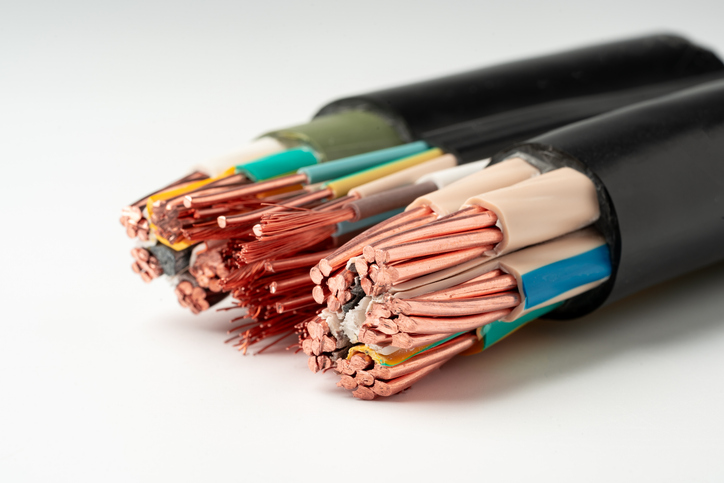
Cable, or cabling, consists of the twisting together of two or more insulated conductors.Learn More
High Voltage Wire & Cable Guide
High-voltage or HV wire and cable are necessary for many industrial applications that rely on dependable high-power transmission. Whether you’re looking for the right HV cable for your application or trying to learn more about how HV wire and cable work, we’ll break it down for you.Learn More
How to Choose the Right Wire or Cable
In selecting a wire or cable for an application, several factors should be considered. Learn More